
Lars Hansen · 5 October 2026
Mapping Real-Time Trigger Responses to Refine Enterprise Lead Scoring Models in Fragmented Tech Stacks
Enterprise organizations continue to face challenges when their marketing, sales, and customer data platforms operate in isolation, and mapping real-time trigger responses offers one approach to improve lead scoring accuracy in such environments. Data from multiple sources shows that companies using disconnected tools often experience delays in updating lead scores because events from one system do not automatically influence models housed in another. Researchers at institutions like the University of Toronto have documented how trigger events, including form submissions or product page views, can feed directly into scoring algorithms when proper mapping layers exist between platforms.
Understanding Fragmented Tech Stacks in Enterprise Settings
Fragmented tech stacks arise when departments adopt separate solutions for CRM, marketing automation, analytics, and customer support without unified data pipelines, and this separation creates gaps in how lead behavior gets recorded and scored. Studies from academic sources indicate that enterprises with more than five core platforms report lower data consistency compared to those with integrated environments, because each system records events using different schemas and timestamps. Observers note that these inconsistencies become particularly evident when attempting to correlate a trigger from a website analytics tool with a subsequent action logged in a separate sales force automation system.
Real-time trigger responses refer to the immediate detection and processing of user actions across these platforms, such as a webinar registration or an abandoned cart event, and mapping these responses involves defining rules that translate raw event data into adjustments within lead scoring models. Figures from industry reports reveal that organizations implementing such mappings see faster qualification cycles, since scores update as events occur rather than during scheduled batch processes that may run only once daily.
Techniques for Mapping Triggers to Scoring Adjustments
Mapping begins with cataloging all detectable events across the stack and assigning each one a weight or transformation rule that aligns with existing scoring criteria, and teams often start by identifying high-frequency triggers like email clicks or content downloads that historically correlate with purchase intent. Data shows that when these mappings incorporate conditional logic, such as increasing a score only if the trigger follows a previous event within a set timeframe, the resulting models better reflect buyer progression through fragmented systems. Experts have observed that without this conditional layer, isolated triggers can produce inflated scores that do not account for sequence or context.
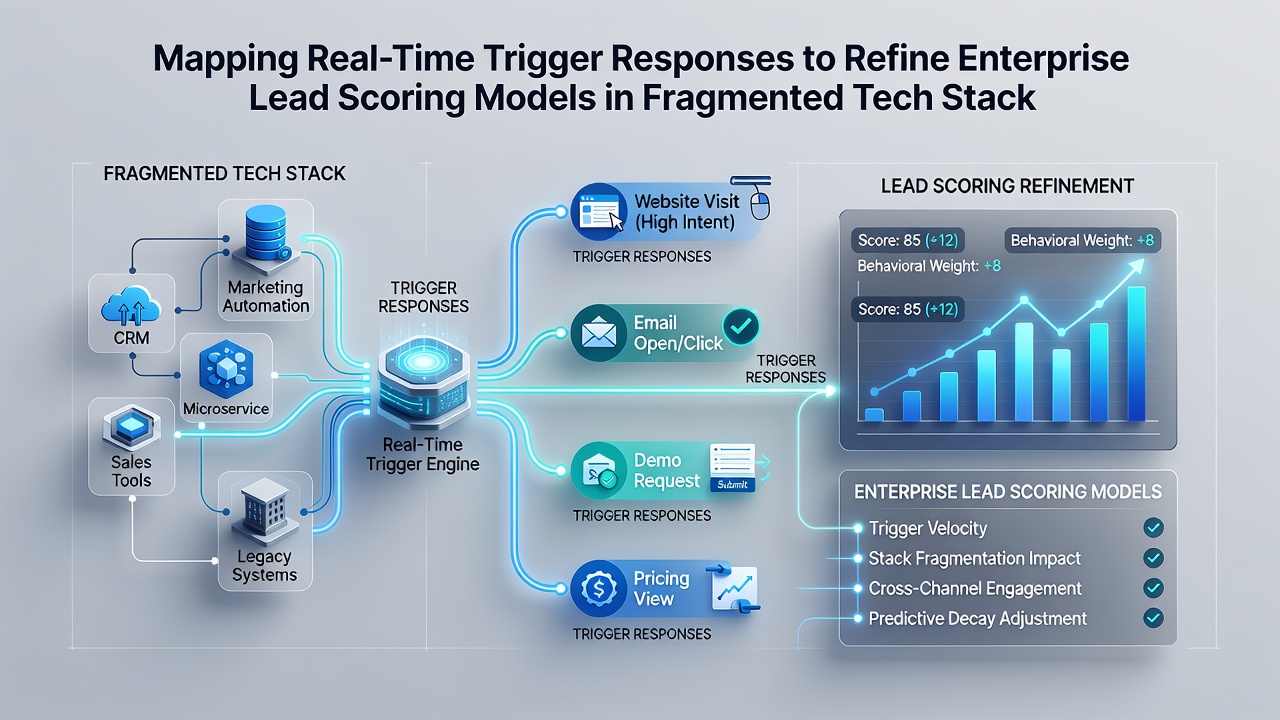
Implementation typically involves middleware or event buses that listen for changes in one platform and push transformed data to the scoring engine in another, and several enterprises have adopted open standards for event formatting to reduce the custom coding required for each new integration. As of October 2026, platform vendors have expanded support for these standards, allowing faster deployment of mapping rules across previously incompatible tools. One study revealed that companies applying these techniques reduced manual score overrides by noticeable margins because automated updates handled routine trigger responses consistently.
Impact on Lead Scoring Accuracy and Qualification Timelines
Refined scoring models that incorporate mapped real-time triggers produce scores that more closely track actual engagement patterns across disconnected systems, and this alignment helps sales teams prioritize leads that demonstrate coordinated activity rather than isolated actions. Research indicates that enterprises using such approaches report higher conversion rates from marketing qualified leads to sales accepted leads, since the scoring reflects a broader view of prospect behavior. Those who have studied these implementations note that the key lies in continuous validation of mapping rules against outcome data, ensuring that trigger weights remain relevant as market conditions or product offerings evolve.
Additional benefits appear when mapping extends to negative signals, such as repeated support ticket submissions or long periods of inactivity, because these can automatically lower scores and prevent resources from being allocated to low-potential prospects. Data from various sectors demonstrates that balanced inclusion of both positive and negative triggers creates more stable models that perform consistently even when new platforms are added to the stack.
Conclusion
Mapping real-time trigger responses provides enterprises with a structured method for improving lead scoring within fragmented technology environments, and the approach relies on clear event definitions, conditional logic, and reliable data movement between platforms. Organizations that establish these mappings continue to update their models based on observed outcomes, maintaining relevance as tech stacks expand or contract over time.